Zambia Energy Demand Stimulation Incentive programme: Driving Productive Use of Energy and Energy Access
We are launching The Zambia Energy Demand Stimulation Incentive (ZEDSI) programme to support 100 + mini grid projects in Zambia. The Call for Proposals is now open
.png)
Zambia Energy Demand Stimulation Incentive Programme (ZEDSI)
CLICK HERE TO REGISTER FOR THE CALL FOR PROJECT APPLICATION
Call for Project Application
Mini-grid operators are invited to submit their project application for grant funding under the Zambia Energy Demand Stimulation Incentive (ZEDSI) programme. Applications are ongoing and can be submitted on a rolling basis with expected mini-grid installations by Q3 2026.
Sustainable Energy for All (SEforALL), , in collaboration with The Rockefeller Foundation and the Global Energy Alliance for People and Planet (GEAPP) is supporting the Government of Zambia’s Presidential Initiative with the objective of powering 1,000 communities with decentralized renewable energy (DRE) solutions by 2030. SEforALL has designed a two-track approach to achieve this objective and address the unique challenges of the Zambian rural electrification market.
Track 1: Zambia Energy Demand Stimulation Incentive (ZEDSI): This Results-Based Financing incentive is designed to support the commercial viability and sustainability of a first set of 100+ priority mini-grid projects. Administered by the Universal Energy Facility and managed by SEforALL provides grant funding to mini-grid operators to stimulate sustained energy consumption growth, through productive uses of energy in agri-value chains, businesses, public institutions and households, resulting in rural economic development, improved revenues and operating margins thereby enhancing the commercial viability of mini-grid projects.
Track 2: Integrated Framework for Electrification: SEforALL is providing support to the government of Zambia to develop and implement investment strategies to scale-up financing inflows into the DRE sector to get from 100+ communities to 1,000 communities. Developers will be empowered to exploit synergies between various DRE technologies, ensuring no-one is left behind. The goal is to develop sustainable models for DRE investments that can be replicated at scale, building on the learnings drawn from the ZEDSI programme.
Under Track 1, the Universal Energy Facility (UEF) will support mini-grid operators to undertake demand stimulation activities – by providing grant funding to eligible mini-grid projects upon verification of sustained electricity consumption and revenue growth via productive uses of energy. Demand stimulation activities are those operational activities that directly result in increased electricity consumption and revenue growth for the mini-grid project which provides adequate, reliable electricity to agri-value chains, businesses, public institutions and households engaged the in the production of good or services.
Mini-grid operators are required to take an ecosystem approach to ensure the commercial viability and sustainability of their projects. The ZEDSI programme complements other existing donor funding including the Beyond the Grid Fund for Africa (BGFA), European Union, United Nations Development Programme (UNDP) and the World Bank that collectively supports the DRE sector in Zambia.
The Call for Project Applications Is Open.
Developer Applications can be submitted on the UEF Platform on a Rolling Basis. Kindly note that all applications received shall be processed on a First-come, First-served basis.
Funding:
Eligible mini-grid operators will receive a share of US$1.4 million upon installation and commissioning of mini-grid projects and verification of sustained customer electricity utilization and revenue growth resulting from the demand stimulation activities.
Tender Approach:
The Results-Based Financing approach will be implemented which allows eligible mini-grid operators to select and prepare their projects end-to-end and achieve the pre-defined project outcomes/results.
Eligible mini-grid operators that meet the application requirements will be awarded grant funding on a First-come, First-served basis. Applications can be submitted on a Rolling Basis – allowing eligible mini-grid operators to participate in the ZEDSI programme once they meet the application requirements.
Eligibility Requirements:
Interested Applicants must fulfil the following eligibility requirements:
- Must be a for-profit mini-grid company legally registered with established business operations in Zambia with relevant business/trading license
- Must have at least one (1) operational mini-grid project in any sub-Saharan Africa country with operational capability to develop and implement new mini-grid projects as well as undertake the sales and operation of productive use appliances/equipment in Zambia
- Must provide evidence of ability to construct new mini-grid projects under the ZEDSI Programme within 18 months
- Must provide Smart Meter integration (both Bulk Meter at the Mini-grid Plant and Customer Metering) with details of API enabled Customer Relationship Management or Payment system to be integrated with UEF Platform
- Must provide evidence of ability to undertake rural economic development activities and business models to drive electricity demand and revenue growth
- Must provide evidence of compliance with financial reporting requirements, including audited financial reports and company tax clearance no older than recently past 12 months
- Must comply with product quality and minimum service standard; environmental and social management systems; and gender and youth mainstreaming requirements
An Applicant may be:
- A single legal entity: for-profit Mini-grid company, licensed to conduct business in Zambia and in good standing with all relevant authorities.
- A single legal entity meeting the criteria in 2.4.2(a) representing an unincorporated/unregistered Consortium or joint venture which will be authorised in writing by members of the Consortium or joint venture to act as Lead Applicant; or
- A Consortium that is incorporated/registered as a single legal entity in Zambia, having the capacity to enter a contract under the relevant laws of the country and is in good standing with all relevant authorities.
- In the case of a Consortium: the Lead Applicant must be a mini-grid company. The Lead Applicant can only submit one Application for a portfolio of mini-grid projects. However, a PUE distributor/supplier can be included as a collaborator in more than one Lead Applicant’s application whether in collaboration with a sole Applicant or as part of a Consortium. In essence, a PUE distributor/supplier may be part of multiple applications in conjunction with more than one applicant.
Application Documents
Below is a list of application documentation that must be provided as part of the application:
Application Process
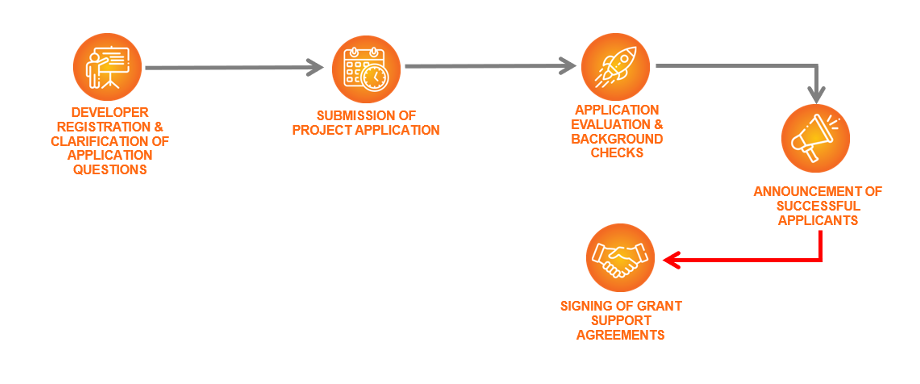
Application Steps
Step 1 – Eligible Applicants must Register their Interest to Apply via this registration page
Step 2 – Upon receipt of Registration and subject to meeting the eligibility requirements, the UEF will create a Log-in account for the Applicant on UEF Online Platform.
Step 3 – Applicants are required to download and review the ‘application documents and templates’ available on the Online Platform before starting their Project Application.
Step 4 – Applicants must complete the Online Application Form and submit all supporting documentation via the UEF Online Platform.
Step 5 – Successful Applicants shall undergo further background checks to validate their application prior to award of Grant Support Agreement.
If you have any questions or require further information, contact us on: UEF@seforall.org
Discover
our programmes
They are all about making a real difference. We fight energy poverty and help communities thrive!
Looking to fund a programme?
Get started now
Choose a path to making sustainable energy for all a reality.
Fund a programme
Lorem ipsum dolor sit amet, consectetur adipiscing elit. Suspendisse varius enim in eros elementum tristique. Duis cursus, mi quis viverra ornare, eros dolor interdum nulla, ut commodo diam libero vitae erat. Aenean faucibus nibh et justo cursus id rutrum lorem imperdiet. Nunc ut sem vitae risus tristique posuere.
Build your own programme
Lorem ipsum dolor sit amet, consectetur adipiscing elit. Suspendisse varius enim in eros elementum tristique. Duis cursus, mi quis viverra ornare, eros dolor interdum nulla, ut commodo diam libero vitae erat. Aenean faucibus nibh et justo cursus id rutrum lorem imperdiet. Nunc ut sem vitae risus tristique posuere.
Frequently
Asked Questions
We put together a series of questions our team have received at different stages of the implementation of our programmes.
Still have a question?
Please reach out to us. We would be delighted to clarify any of your queries.
Mini-grids Programme
Mini-grid projects proposed by the applicants will be evaluated by the UEF to ensure they meet a minimum level of development in order to be eligible for a grant from the UEF. Pre-qualified applicants must be able to demonstrate that they have community, local government, and national government support for proposed projects, in the form of relevant licenses, permits, letters, and other documentation.
In the current Project Application Collections, only projects utilizing solar PV as their primary generation technology are eligible for funding. While diesel generators and other non-renewable backup power sources can be included in a project, they must not exceed 40% of power generation in any given fiscal quarter. Additional eligible generation technologies may be announced in future Project Application Collections.
Applicants can apply for multiple projects; however, each project must meet the eligibility criteria and be submitted within the specified application windows for the relevant countries.
The grant disbursement of USD 592 per electricity connection is based on verified results. As part of the grantee’s claims report, the UEF performs remote connection verification through the UEF Platform. For remote verification, the UEF Platform enables grantees to verify the existence and consumption of every connection reported over a 30-day period through smart meters built in as part of each connection. In addition to remote verification of connections, the UEF Programme Manager conducts random on-site verifications to ensure grantees are in compliance with agreed standards and other terms. The UEF Programme Manager verifies the deployments and connections, and payments are made upon final approval.
No, the UEF does not provide pre-financing for projects. The programme disburses grant payments based on a results-based incentive model, where payments are made only after verified and approved milestones by the UEF Programme Manager. The UEF provides direct grant payments on a “results-based” basis to grantees, upon the satisfaction of three milestones: (1) Proof of delivery of the major project equipment to the approved project site; (2) Successful commissioning of the mini-grid; and (3)Submission of claims report which cover connections established by the grantee and verification of connections which meet technical standards and provide stable power supply for at least 30 days after commissioning. Applicants must demonstrate sufficient financial resources to develop, construct, commission, and operate their mini-grid projects independently before receiving any grant disbursements.
SSPU Programme
CAPEX is determined by the actual cost incurred by the applicant to purchase the hardware components. Applicants shall be required to provide evidence of the Landing costs (for imported systems), or the Invoiced prices (for systems sourced locally), including payment receipts in the Claims Report stage of the UEF process.
Yes, DC systems larger than 100W and capable of powering productive use appliances are eligible.
No, there is no substitute for the ‘cash-inbank' requirement.
Where applicable, applicants may in addition also submit a binding letter of financial commitment from financiers or an asset financing agreement with OEM.
The 30% Installation Payment will be paid at least 30 business days after deployment and verification of Claims.
The 10% Sustainability Payment will be paid at the end of the Grant Agreement period.
Once Pre-qualified, any changes to the approved Company Structure after being pre-qualified must seek further approval from the UEF Advisory Board.
Media kit
Contact our team for media enquiries.